
Form I-130A Explained for Marriage-Based Green Card Applicants
Author: Grace Remington, Esq.
Introduction
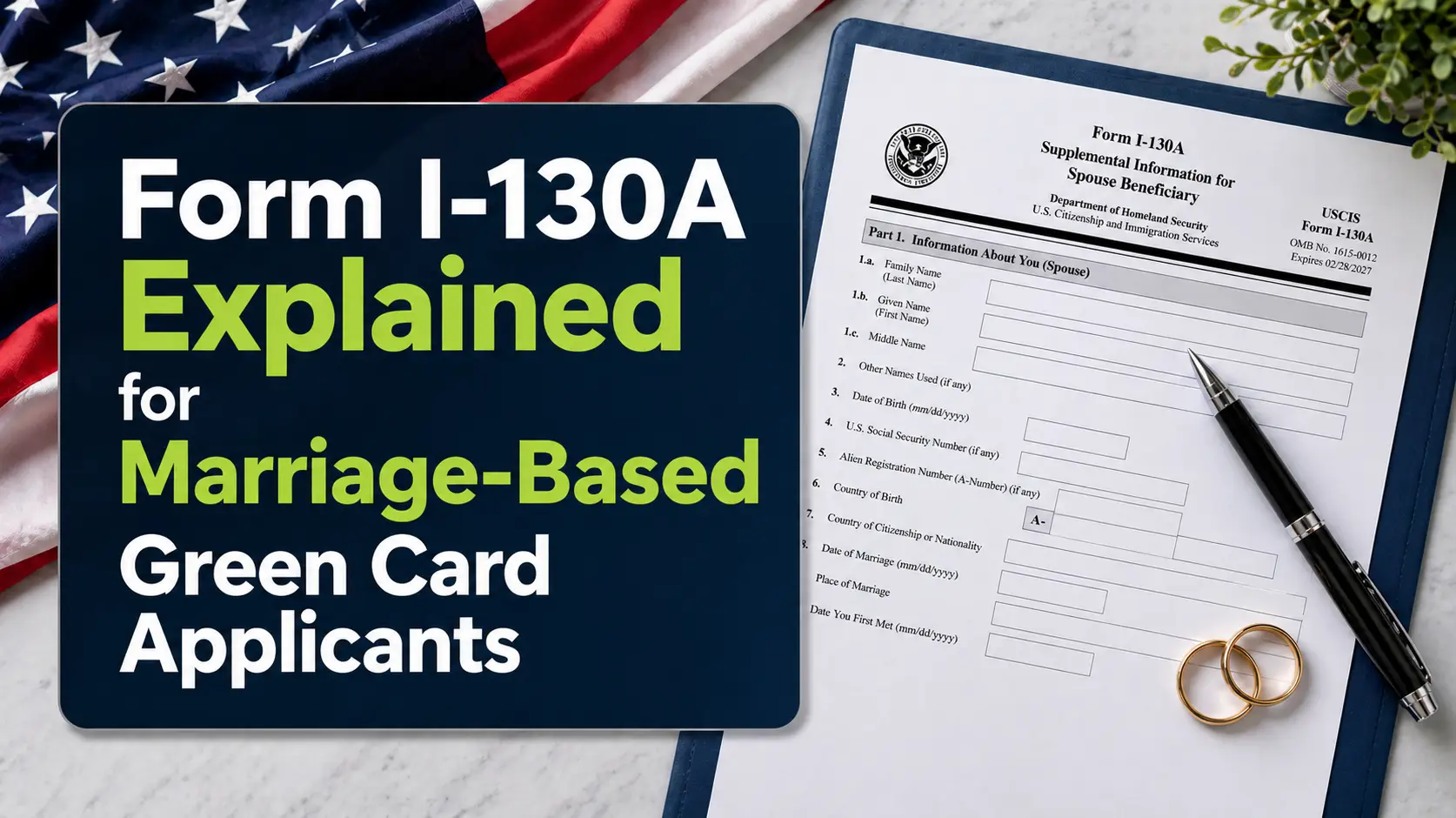
Marriage-based green card cases often involve multiple forms working together. One of the most commonly misunderstood is Form I130A, Supplemental Information for Spouse Beneficiary, which supplements the main family petition and provides detailed background information about the beneficiary spouse.
Clients frequently ask who needs to complete it, whether it is filed together with the I-130, and how it affects the overall case. Understanding its role helps ensure a smoother and more consistent filing.
What Is the Form I-130A
Form I130A is a supplemental form used when a U.S. citizen, lawful permanent resident, or noncitizen U.S. national files Form I-130 for a spouse. It provides detailed biographical and background information about the spouse beneficiary.
For marriage-based Form I-130 filings, Form I130A is the form used to collect the spouse beneficiary’s address history, employment history, parent information, and related background details.
Quick note: Form I130A is not the main family petition. It supplements the I-130 in a marriage-based case.
The main petition, Form I-130, establishes the qualifying relationship. Form I130A supports that petition by providing additional details that help USCIS assess identity, history, and consistency across records.
Who Usually Needs to Complete Form I-130A
| Person | High-level role |
|---|---|
| Petitioning spouse | Files the main family petition and initiates the process |
| Beneficiary spouse | Completes Form I130A to provide detailed personal and background information |
| Couple together | Must ensure both forms are consistent and aligned across all information provided |
The spouse beneficiary generally must complete and sign Form I130A. If the spouse beneficiary lives overseas, the form still must be completed, but the overseas spouse generally does not need to sign it. Both spouses should make sure the information is accurate and consistent across the filing.
What Information Does the Form Request?
- Personal identity information, including full legal name and prior names used
- Address history for the time period requested on the current USCIS form (typically the last 5 years), with no unexplained gaps or overlapping dates
- Employment history with dates, locations, and employer details
- Parent information and basic family background
- Contact details and current residence information
- Additional explanations for gaps, inconsistencies, or unusual circumstances
The information allows USCIS to evaluate the beneficiary spouse’s background and compare it against prior filings and government records.
How Form I-130A Fits into the Overall Case
After USCIS approves Form I-130, the next steps depend on whether the spouse beneficiary will pursue adjustment of status in the United States or consular processing abroad.
Approval of Form I-130 confirms the qualifying family relationship, but it does not by itself grant a green card, lawful status, or work/travel permission.
| Spouse in the U.S. | Spouse outside the U.S. |
|---|---|
| May be submitted as part of a concurrent filing package with adjustment of status | After I-130 approval, the case may move to the National Visa Center for consular processing, where the applicant submits fees, forms, and civil documents before an immigrant visa interview can be scheduled |
| In an adjustment of status case, the broader filing package may affect biometrics, work authorization, travel document, and interview timing. Form I130A itself does not create a separate work authorization or travel benefit | Information may be reviewed again during visa processing |
| Background information may be reviewed alongside other forms | Consistency with later forms submitted to USCIS or the Department of State is important |
Why Accuracy on Form I-130A Matters
Form I130A is often compared against prior filings, visa applications, and government records. Even small inconsistencies may raise questions about completeness, accuracy, or whether the information matches other records.
Common Issue
Missing dates, gaps, or conflicting background details
may lead to questions or delay case review.
Common Problematic Areas
- Missing address periods that create unexplained gaps in residence history
- Incomplete job history, especially where informal or overseas employment is involved
- Unclear or inconsistent dates that do not align across documents
- Conflicting prior information from earlier visa applications or filings
- Missing signatures or incomplete sections of the form
- Unexplained gaps in employment, residence, or travel history
These issues do not automatically result in denial, but they can lead to follow-up questions, a request for evidence, or processing delays.
Filing and Logistics Concerns
Clients often ask whether the forms must be filed together. In most marriage-based cases, Form I-130 and Form I130A are submitted at the same time to avoid delays or requests for missing information.
| Question area | What to consider |
|---|---|
| How it is submitted | Form I130A must be submitted with Form I-130 when the petitioner is filing for a spouse |
| Online or paper filing | It may be filed online or by mail. In an online I-130 filing, Form I130A is generally included as a supporting document rather than filed as a separate standalone online form |
| Separate fee questions | There is no separate USCIS filing fee listed for Form I130A. The required filing fee is for Form I-130, and applicants should always confirm the current I-130 fee on the USCIS website before filing |
| Processing questions | Form I130A does not have its own separate approval or independent processing timeline. It is reviewed as part of the Form I-130 spousal petition |
When Legal Guidance May Help
When to Take a Closer Look
If the spouse has long address gaps, complex work history, or prior filing inconsistencies, careful review may help avoid errors that could affect case review.
Legal guidance may also be helpful where prior visa applications, travel history, or name variations could create inconsistencies across records.
Frequently Asked Questions
-
- Q: What is Form I-130A?
- A: It is a supplemental form used in marriage-based cases to provide detailed background information about the beneficiary spouse.
-
- Q: Who needs to fill out Form I-130A?
- A: The beneficiary spouse typically completes the form, although both spouses are responsible for ensuring accuracy.
-
- Q: Is Form I-130A required for every marriage-based green card case?
- A: It is generally required when a U.S. citizen, lawful permanent resident, or noncitizen U.S. national files Form I-130 for a spouse.
-
- Q: What is the difference between Form I-130 and Form I-130A?
- A: Form I-130 establishes the qualifying family relationship, while Form I-130A provides detailed background information about the beneficiary spouse.
-
- Q: What information does Form I-130A ask for?
- A: It requests personal details, address history, employment history, family information, and related background information.
-
- Q: Does Form I-130A have a separate filing fee?
- A: No. It is typically included as part of the I-130 filing without an additional fee.
-
- Q: Can Form I-130A be filed online?
- A: Form I-130 can be filed online through USCIS. Form I-130A is usually included with the I-130 filing materials rather than submitted as its own separate online application.
-
- Q: What happens if Form I-130A is incomplete?
- A: USCIS may issue a request for evidence or delay processing until the missing information is provided.
-
- Q: Does Form I-130A have its own processing time?
- A: No. It is reviewed together with the I-130 petition.
-
- Q: When should I speak with an immigration lawyer about Form I-130A?
- A: If there are inconsistencies, gaps, or complex background issues, legal guidance may help ensure the form is completed accurately.
Conclusion
Form I130A plays a supporting but important role in marriage-based immigration cases, and applicants often seek guidance through an experienced immigration lawyer. While it is not the primary petition, it provides critical background information that USCIS uses to evaluate the case.
Careful completion, consistency across records, and attention to detail can help reduce delays and support a smoother overall process, particularly for those planning long-term goals such as naturalization.



Michael Ashoori, Esq.
President of Ashoori Law
I’m a U.S. immigration lawyer and I help families, professionals, investors, and entrepreneurs get visas, green cards, and citizenship to the United States.
Since starting my law firm, I’ve helped thousands of people from all over the world with their immigration needs. I’m very passionate, hard-working, and committed to my clients.
Got a question? Send me an email.