
Do You Need an I-551 Stamp? What Green Card Holders Should Know
Author: Grace Remington, Esq.
Introduction
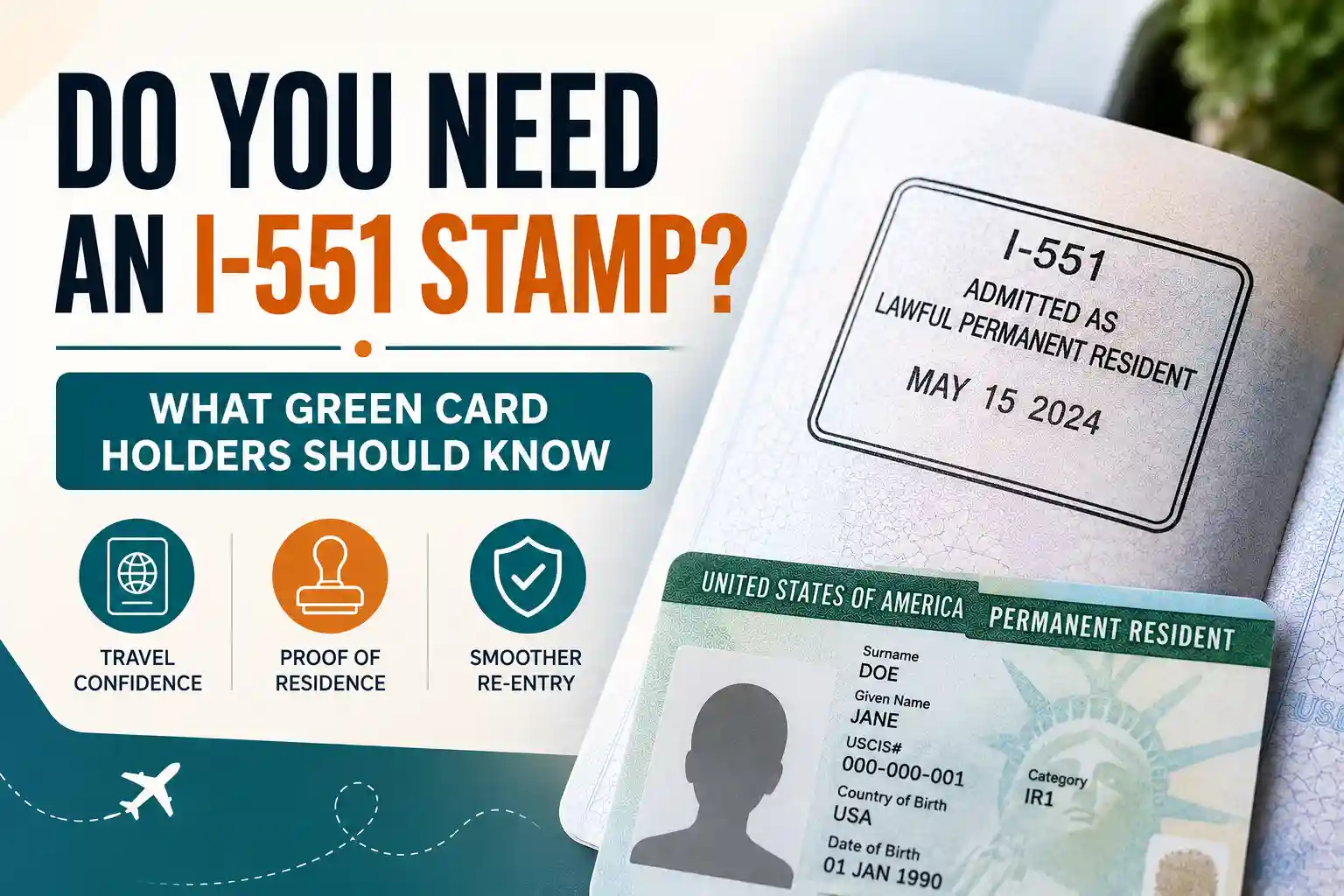
An Alien Documentation, Identification and Telecommunication (ADIT) stamp, also known as an I-551 stamp, may be issued to Lawful Permanent Residents (LPRs) as evidence of their lawful permanent resident status in limited circumstances.
Lawful permanent residents, or ‘green card holders,’ may sometimes need temporary proof of status because their physical green card has been lost, expired, delayed, or not yet received, particularly during a green card renewal.
New immigrants entering the United States with a machine-readable immigrant visa may also receive temporary I-551 evidence upon admission. In these situations, an I-551 stamp may serve as temporary proof of lawful permanent resident status.
Current LPRs, and people who have recently been approved for permanent residence but have not yet received a physical green card, often ask when temporary proof may be needed, whether it can be used for travel or work, and how it differs from the physical green card, especially in cases such as a green card through marriage.
Understanding its purpose and limitations can help avoid unnecessary delays or complications.
What Is the I-551 Stamp?
The I-551 stamp is temporary evidence of lawful permanent resident status. It is often placed in a valid passport, but USCIS may also issue temporary ADIT evidence on Form I-94 in some situations, including by mail when an in-person appointment is not required.
For new immigrants, CBP may endorse a machine-readable immigrant visa at first entry, which can serve as temporary I-551 evidence.
The validity period depends on the document and the circumstances, but USCIS generally does not issue ADIT evidence for more than one year unless regulation or policy provides otherwise.
Quick Note
The I-551 stamp is generally temporary proof of permanent residence.
It is not the same as receiving a new physical green card.
It functions as a short-term substitute when a green card is not available, but it does not replace the need for the actual card.
When Does Someone Need an I-551 Stamp?
Note
Some USCIS receipt notices may already extend green card validity, such as certain I-90, I-751, or I-829 receipt notices. An I-551 stamp may still be needed if that proof is unavailable, insufficient, or does not cover the person’s situation.
Individuals may need an I-551 stamp in the following scenarios:
- Lost green card – A replacement is pending and immediate proof of status is needed
- Expired or expiring green card – A renewal or replacement has been filed, the new card has not arrived, and the person still needs temporary evidence beyond any available receipt-notice extension
- Green card processing or card-production delays – For example, when a person has already been granted LPR status or has a pending renewal/replacement, but the physical card has not yet been received
- Immediate travel needs – When international travel is necessary before receiving the physical card and the person needs temporary evidence of status for travel
- Employment verification – Where an employer needs acceptable Form I-9 documentation showing identity and employment authorization
- Initial U.S. entry with an immigrant visa – When CBP endorses the machine-readable immigrant visa, it can serve as temporary I-551 evidence while the physical green card is being produced
Whether a stamp is appropriate depends on timing, documentation, and the urgency of the situation.
How Can the Stamp Help?
| Use case | What to consider |
|---|---|
| Proof of permanent residence | The stamp may serve as temporary evidence of LPR status when the physical card is unavailable. Depending on the situation, it may help satisfy documentation requests from employers, government agencies, or other institutions while the card is pending or unavailable |
| Employment verification | The stamp may be used for Form I-9 employment verification as a List A document, demonstrating both identity and work authorization during its validity period |
| Travel documentation | The stamp may help an LPR document permanent resident status when returning to the United States after international travel. However, the traveler is still subject to inspection by CBP at the port of entry, and travel can involve additional risks depending on the person’s history, length of absence, and documents |
How Do the I-551 Stamp and Green Card Differ?
The key distinction is that the stamp is a temporary solution, not a replacement for the card itself.
| I-551 Stamp | Physical Green Card |
|---|---|
| Temporary evidence of permanent residence | Primary physical evidence of lawful permanent resident status, usually valid for a set period depending on the card type |
| Often placed in passport | Separate physical identification card |
| Used while card is unavailable or pending | Primary long-term proof of status |
How Applicants May Request the Stamp
To request an I-551 stamp, Lawful Permanent Residents (LPRs) generally need to contact USCIS to schedule an in-person ADIT appointment.
The following steps detail the required records and preparation, including what identification and evidence you must be ready to present during this process:
- Gather supporting records that demonstrate lawful permanent resident status, such as receipt notices, expired green cards
- Request an in-person ADIT stamp appointment with USCIS. In some cases, USCIS may determine that an in-person appointment is not required and may issue temporary ADIT evidence by mail.
- Explain the reason for the request, such as urgent travel, employment verification, or delayed card issuance
- Bring supporting documents such as the appointment confirmation, receipt notices, prior green card if available, and government-issued identity documents such as a driver’s license or passport
- Prepare to show evidence of a pending or approved application related to the green card
- Bring identification documents, including a valid passport, if available. Applicants who do not have a valid passport may need to provide passport-style photos so USCIS can issue temporary ADIT evidence on Form I-94 instead
- Be ready to explain timing needs, especially if travel or employment is involved
- For new immigrants abroad, present a machine-readable immigrant visa (MRIV) at a port of entry when first entering the U.S.
- If you are outside the United States, review the process and instructions applicable to your location before attempting to request temporary evidence.
USCIS generally evaluates requests based on the person’s LPR status, identity, need for temporary evidence, and available documentation. USCIS has discretion to decide whether temporary evidence is appropriate and how long it should remain valid.
What Documents Might Be Needed?
| Document type | High-level purpose |
|---|---|
| Valid passport | Provides identity verification and is a common place for the ADIT/I-551 stamp to be placed. If a passport is unavailable, USCIS may be able to issue temporary ADIT evidence on Form I-94 in some cases |
| Pending case evidence | Helps show that a renewal, replacement, removal-of-conditions petition, or recently approved permanent residence case is pending or documented, and supports the request for temporary evidence of status |
| Prior green card | Helps confirm existing lawful permanent resident status and allows USCIS to verify prior issuance |
| Other records | USCIS receipt notices of any pending immigration benefits or past benefits, police or court documents concerning loss or theft, and other related documents may support consistency across filings and may help resolve discrepancies or questions during the appointment |
How Long May the I-551 Stamp Last?
Validity periods can vary. USCIS generally has discretion to determine the validity period based on the LPR’s situation, but ADIT evidence generally does not exceed one year unless a regulation or policy provides otherwise. The stamp is generally issued for a limited time to bridge the gap until a physical card becomes available.
Important Reminder
The I-551 stamp is usually temporary.
How long it lasts can depend on the case and the stamp issued.
When Legal Guidance May Help
Legal guidance may be particularly helpful where timing and eligibility intersect. For example, if a green card has expired and travel is planned, or if a replacement application is pending but delayed, understanding how USCIS evaluates the request can affect whether the stamp is issued.
It may also be useful where prior immigration history, gaps in documentation, repeat loss or theft, or inconsistencies across filings could raise questions at the appointment or during travel. In these situations, preparation often matters more than the request itself.
If travel is urgent, records are missing, or your case history is complicated,
careful review may help before requesting temporary evidence or making travel plans.
Frequently Asked Questions
-
- Q: What is an I-551 stamp?
- A: It is temporary evidence of lawful permanent resident status, typically placed in a passport and used when the physical green card is not available.
-
- Q: Who can get an I-551 stamp?
- A: It may be issued to lawful permanent residents who need temporary proof of status because their green card is unavailable, expired, lost, delayed, or pending replacement. It may also be relevant for people who have been granted permanent residence but have not yet received the physical card.
-
- Q: Is the I-551 stamp the same as a green card?
- A: No. The stamp is temporary evidence of lawful permanent resident status. A physical green card is the primary card document used to show permanent residence over a longer period.
-
- Q: Can I travel with an I-551 stamp?
- A: In many cases, yes. The stamp may be used for reentry to the United States, but admission is still subject to inspection and review by CBP officers at the port of entry.
-
- Q: Can I work with an I-551 stamp?
- A: Yes. During its validity period, it may serve as proof of both identity and work authorization for employment verification purposes.
-
- Q: How do I get an I-551 stamp from USCIS?
- A: You can request assistance through the USCIS online appointment request tool. You will generally need to explain why you need temporary evidence and provide documents showing your identity, LPR status, and any pending or approved case. USCIS may schedule an appointment or, in some cases, issue temporary ADIT evidence by mail.
-
- Q: What documents do I need for an I-551 stamp appointment?
- A: Common documents may include a valid passport if available, passport-style photos if USCIS needs to issue temporary evidence on Form I-94, a prior green card if available, receipt notices, appointment confirmation, government-issued identity documents, and evidence supporting the reason for the request, such as urgent travel.
-
- Q: How long is an I-551 stamp valid?
- A: It is issued for a limited period. USCIS generally has discretion to set the validity period based on the person’s situation, but ADIT evidence generally does not exceed one year unless regulation or policy provides otherwise.
-
- Q: Is there a fee for an I-551 stamp?
- A: There is typically no separate fee for temporary ADIT evidence itself, but there may be filing fees for an underlying application, such as a green card replacement or renewal application.
-
- Q: When should I speak with an immigration lawyer about an I-551 stamp?
- A: If your situation involves urgent travel, missing documentation, prior immigration complications, or uncertainty about eligibility, legal guidance may help reduce risk and improve preparation.
Conclusion
The I-551 stamp can serve as a practical, temporary form of proof for lawful permanent residents who need evidence of status while waiting for a physical green card or while resolving document issues.
While it can assist with travel, employment, and documentation needs, it is not a substitute for the green card itself.
Understanding when it is appropriate and how it is used can help avoid confusion and support smoother handling of immigration-related situations.



Michael Ashoori, Esq.
President of Ashoori Law
I’m a U.S. immigration lawyer and I help families, professionals, investors, and entrepreneurs get visas, green cards, and citizenship to the United States.
Since starting my law firm, I’ve helped thousands of people from all over the world with their immigration needs. I’m very passionate, hard-working, and committed to my clients.
Got a question? Send me an email.