
EB-1A Criteria: Evidence Guide for Each of the 10 Requirements
Author: Ashoori Law
Reviewed by: Shruti Bali, Esq.
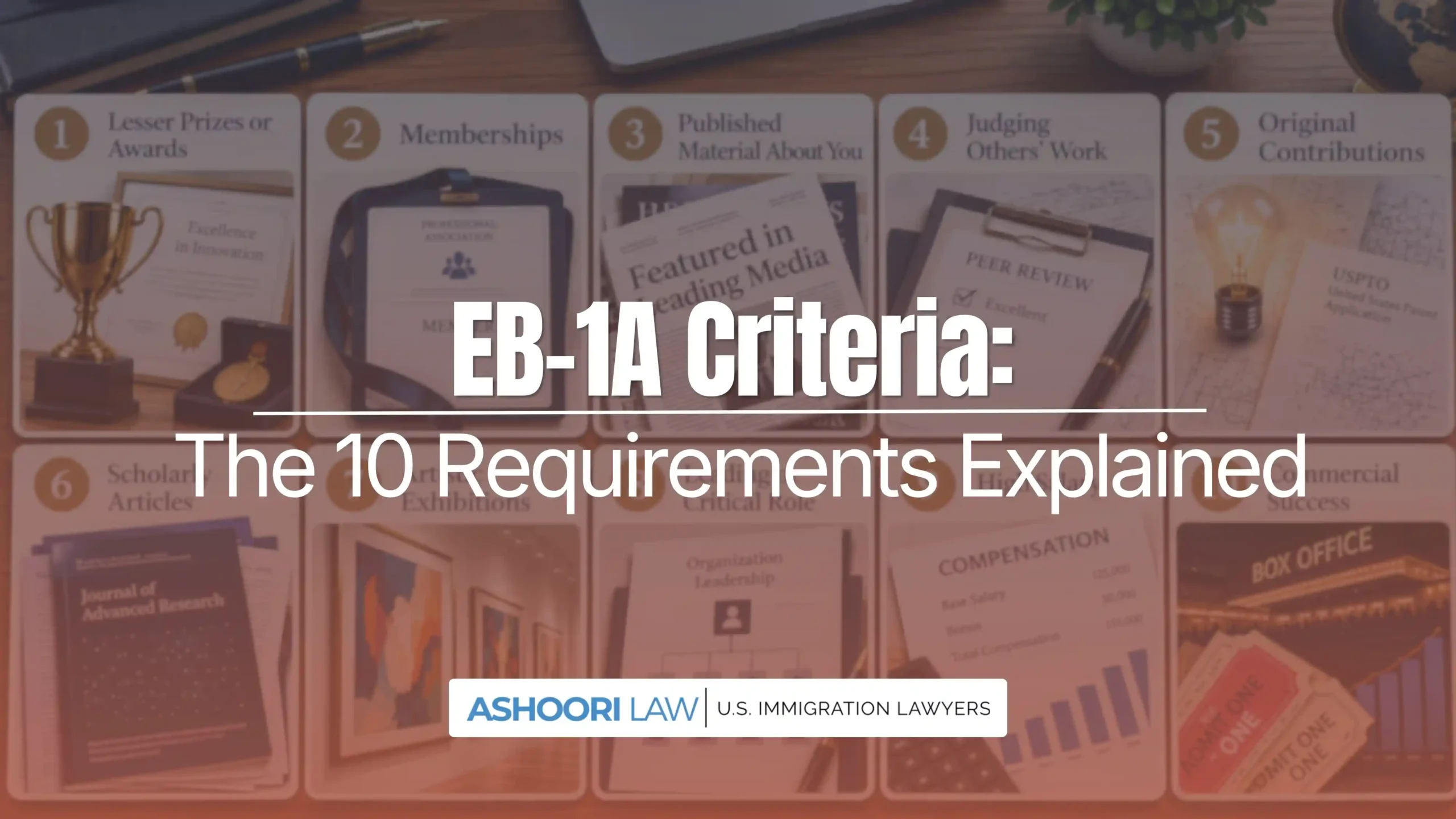
To qualify for an EB-1A green card, you must show either a one-time major, internationally recognized award (such as a Nobel Prize) or meet at least 3 of the 10 evidentiary criteria listed at 8 CFR 204.5(h)(3), and then satisfy a final merits review showing sustained national or international acclaim and that you are among the small percentage at the very top of your field. Because the EB-1A allows self-petitioning, you do not need an employer sponsor, a job offer, or a labor certification (PERM).
This guide explains the EB-1A criteria, the strongest types of evidence for each one, and how USCIS evaluates an EB-1A petition under its current two-step framework.
Key Takeaways
- The evidentiary threshold is a one-time major internationally recognized award, or at least 3 of the 10 criteria at 8 CFR 204.5(h)(3). Meeting 3 criteria is the first step, not the finish line.
- After the criteria count, USCIS performs a final merits determination on the whole record. A petition can satisfy three or more criteria and still be denied at this stage.
- You must also show that you intend to continue working in your area of extraordinary ability in the United States and that your entry will substantially benefit the United States in the future.
- No employer, job offer, or PERM labor certification is required. You file Form I-140 for yourself.
- As of September 30, 2026, the Form I-140 filing fee is $715 plus a $300 Asylum Program Fee for individual self-petitioners, and optional premium processing on Form I-907 costs $2,965 for requests postmarked on or after March 1, 2026. Confirm all amounts on the live USCIS Fee Schedule (Form G-1055) before filing.
- Whether you can file Form I-485 with your I-140 depends on the Department of State Visa Bulletin for your country of chargeability (generally your country of birth), and EB-1 is not always current for every country.
What is the EB-1A: Extraordinary Ability category?
Can I get a green card without an employer or job offer? In employment-based green card categories that require sponsorship, an employer must file an immigrant petition on your behalf and offer you a job. The EB-1A category is different. Under the EB-1A, you can self-petition, meaning you file the Form I-140 for yourself without an employer sponsoring you. There is also no labor certification (PERM) requirement, which in other employment-based categories adds a prevailing wage determination, an employer recruitment process, and Department of Labor processing before the immigrant petition can even be filed. Premium processing is available for EB-1A petitions, which shortens the decision timeline on the Form I-140 itself. For premium processing requests postmarked on or after March 1, 2026, the Form I-907 fee for an I-140 is $2,965 (it was $2,805 for requests postmarked before that date). Once USCIS receives a properly completed Form I-907 with the correct fee, it must take adjudicative action (an approval, denial, notice of intent to deny, or request for evidence) within 15 business days under 8 CFR 106.4. If USCIS issues a request for evidence or notice of intent to deny, the clock stops, and a new 15-business-day period begins when USCIS receives your response. Premium processing does not change the eligibility standard or guarantee an approval, and overall timelines vary and can change.
What are the EB-1A requirements?
The EB-1A is reserved for people with extraordinary ability in the sciences, arts, education, business, or athletics. Under INA 203(b)(1)(A) and 8 CFR 204.5(h), you must show all of the following:
- Extraordinary ability demonstrated by sustained national or international acclaim, with achievements recognized in the field through extensive documentation;
- That you seek to enter the United States to continue working in your area of extraordinary ability; and
- That your entry will substantially benefit the United States in the future.
On the evidence side, the regulation gives you two paths. You can document a one-time achievement, meaning a major, internationally recognized award (a Nobel Prize is the classic example). If you do not have that, you must submit evidence meeting at least 3 of the 10 criteria listed at 8 CFR 204.5(h)(3)(i) through (x).
There is also a flexibility provision. Under 8 CFR 204.5(h)(4), if the listed criteria do not readily apply to your occupation, you may submit comparable evidence. USCIS evaluates whether the standard criteria are in fact not readily applicable to your occupation and whether the alternative evidence you submit is genuinely comparable in significance to the criterion it stands in for.
What evidence supports each EB-1A criterion?
Here is a summary of the ten criteria, followed by detailed evidence guidance for each.
| Criterion (8 CFR 204.5(h)(3)) | Core requirement | Sample evidence |
|---|---|---|
| (i) Lesser prizes or awards | Nationally or internationally recognized awards for excellence in the field | Award certificate, selection criteria, press coverage for the award, documents pertaining to the awarding agency |
| (ii) Memberships | Associations requiring outstanding achievement, judged by recognized experts | Membership confirmation, admission criteria, letter from agency confirming the criteria used for admission, profiles of the experts who approved the admission |
| (iii) Published material about you | Coverage of you in professional, major trade, or other major media | Articles, interviews, outlet circulation data |
| (iv) Judging | Judging others’ work in the same or an allied field | Invitations plus proof you completed the review |
| (v) Original contributions | Contributions of major significance to the field | Expert letters, evidence of adoption or impact, patents |
| (vi) Scholarly articles | Authorship in professional, major trade, or other major media | Publications, journal standing, citations |
| (vii) Artistic exhibitions | Display of your work at exhibitions or showcases | Brochures, posters, press about the exhibit |
| (viii) Leading or critical role | Role for organizations with a distinguished reputation | Role letters, org charts, evidence of the organization’s reputation |
| (ix) High salary | Remuneration high relative to others in the field | Pay records plus comparative wage data |
| (x) Commercial success | Commercial success in the performing arts | Box office, sales, ratings, royalty records |
Evidence of receipt of lesser nationally or internationally recognized prizes or awards for excellence
- USCIS does not exclude an award simply because eligibility was limited to students or early-career entrants. The officer examines the award’s national or international recognition, the pool of people eligible to compete, the selection criteria, its geographic scope, and the number of recipients. A student or early-career award can satisfy this criterion if it is nationally or internationally recognized for excellence in the field, and its significance is then weighed again at the final merits stage;
- Use printouts from the awarding organization’s website or publications showing the selection criteria, the number of applicants or entries the year you won, and information about the awarding body;
- Include press from significant publications covering the award and your receipt of it;
- Evidence can include: photos of your award (with your name clearly legible), a congratulatory letter from the organization, a scan of the award certificate, or confirmation from the awarding committee. USCIS guidance also recognizes certain team awards where each member is named or individually recognized.
Evidence of membership in associations in the field that require outstanding achievement of their members, as judged by recognized national or international experts
- You can submit a printout from an online member database showing your membership, a copy of your membership card, or a confirmation letter from the association;
- Submit a letter or screenshots from the organization documenting the membership criteria, and showing that admission requires outstanding achievement judged by recognized experts. Paying a fee or meeting open enrollment requirements alone generally does not establish this standard;
- Add any publications covering the selectivity of the organization’s membership.
- Add information about the experts who approved your membership if available
Evidence of published material about you in professional or major trade publications or other major media
- Provide press materials about you and your work in the field. These can include interviews, article printouts, and radio or television appearances. The material should be about you and relate to your work, and should identify the title, date, and author where applicable;
- Provide evidence of the standing of each outlet (circulation, audience, or ranking data) to show it qualifies as a professional publication, major trade publication, or other major media.
Evidence that you have judged the work of others in your field or an allied field, either individually or on a panel
- Provide emails or letters inviting you to serve as a judge, peer reviewer, or panel member, and confirmation that you actually completed the review (a thank-you email or reviewer record works);
- Other evidence can include screenshots or printouts from the press or the organization listing you as a jury or panel member;
- Add printouts from the organization describing the qualifications required of its judges.
Evidence of your original scientific, scholarly, artistic, athletic, or business-related contributions of major significance to the field
- Submit letters from professionals in your field explaining what your contribution is, why it is original, and how it has influenced the field. Under USCIS guidance, letters carry weight based on their specificity, factual support, and consistency with the rest of the record. Letters from independent experts (people who have not worked with you and are unaffiliated with you), when specific and corroborated by other evidence, can be especially persuasive because they show recognition beyond your own circle;
- A patent, whether pending or granted, ordinarily does not by itself establish that a contribution is of major significance. Under USCIS guidance, patents can show originality, but you should pair them with evidence of impact or adoption: licensing contracts, use of the invention by others in the field, citation records, or press about the invention.
Evidence of your authorship of scholarly articles in professional or major trade publications or other major media
- Submit your published articles showing your name as an author;
- Add evidence of the publication’s standing: circulation figures, journal ranking or impact metrics, or website traffic data. Citation counts to your articles are also useful, particularly for the final merits stage.
Evidence that your work has been displayed at artistic exhibitions or showcases
- Submit brochures, posters, advertisements, or photos of the exhibits, making sure your name is clearly identified as the artist whose work was displayed;
- You can also submit press about the exhibition or printouts from the gallery or organization’s website covering attendance figures, critical reviews and audience response, and the venue’s prestige. This criterion applies to displays of artistic work.
Evidence that you have performed a leading or critical role for organizations or establishments with a distinguished reputation
- Show evidence of a leading role (for example, executive, department head, or chair) or a critical role, meaning your contribution was of significant importance to the organization’s outcomes, regardless of title. A letter from the organization explaining your role and its importance is strong evidence;
- Organizational charts can demonstrate a leading role within the group’s hierarchy;
- Include internal awards reserved for the organization’s leaders;
- Include independent articles or other material establishing the organization’s distinguished reputation: awards received by the entity, its size, revenue or endowment, media coverage, and profiles of its leadership. Both elements (your role and the organization’s reputation) must be documented.
Evidence that you command a high salary or other significantly high remuneration in relation to others in the field
- Submit tax documents, recent pay statements, or contracts showing your compensation;
- Submit comparative data (for example, government wage surveys or credible industry salary data for your occupation and geographic area). USCIS evaluates whether your remuneration is high relative to others in the field, so comparative evidence is needed to establish this criterion.
Evidence of commercial success in the performing arts
- Submit box office receipts, record or streaming sales, TV ratings, or audience statistics;
- Press discussing the commercial success of your project; or
- Tax documents or payment records showing royalties and performance revenue. This criterion applies only to the performing arts.
What are some additional considerations, besides meeting 3 of the 10 criteria?
The Two-Step Analysis: Kazarian and the Final Merits Determination
In 2010, the Ninth Circuit Court of Appeals decided Kazarian v. USCIS, 596 F.3d 1115 (9th Cir. 2010), which shaped how USCIS structures EB-1A adjudication. USCIS first issued a policy memorandum implementing the decision, and that framework is now set out in the USCIS Policy Manual (Volume 6, Part F, Chapter 2). The Policy Manual is USCIS’s current controlling internal policy guidance for its adjudicators; the binding eligibility standards remain the statute and regulations (INA 203(b)(1)(A) and 8 CFR 204.5(h)). Under this two-step analysis:
- Step one (initial evidence): the officer determines whether you have documented a one-time major, internationally recognized achievement or meet at least 3 of the 10 regulatory criteria (counting the evidence against each criterion’s plain requirements);
- Step two (final merits determination): the officer evaluates the totality of the evidence to decide whether it shows sustained national or international acclaim and that you are among the small percentage at the very top of your field.
In addition to the two-step evidentiary analysis, the statute and regulations require you to show:
- That you intend to continue working in your area of extraordinary ability in the United States (USCIS accepts evidence such as letters from prospective employers, contracts, or a detailed statement of your plans); and
- That your entry will substantially benefit the United States in the future, a requirement USCIS assesses case by case.
For these last two elements, it helps to document concrete, near-term plans: prospective positions, projects, funding, or engagements in your field. USCIS updated its Policy Manual guidance on EB-1A evidence in October 2024, clarifying, among other points, how it treats team awards and past memberships, so make sure your evidence is framed against the current guidance rather than older memoranda.
What forms do I need to file an EB-1A?
As with any employment-based green card petition, you must file a Form I-140, Immigrant Petition for Alien Workers, with the required fees and evidence. Under the USCIS fee schedule in effect since April 1, 2024, the base I-140 filing fee is $715, and an Asylum Program Fee also applies to I-140 filings. Individual self-petitioners pay the reduced Asylum Program Fee of $300 (nonprofits pay $0 and other employers pay $600), so an individual EB-1A self-petitioner generally pays $1,015 in mandatory fees before optional premium processing. Confirm the amounts on the live USCIS Fee Schedule (Form G-1055) before filing. Premium processing via Form I-907 is optional and costs $2,965 for requests postmarked on or after March 1, 2026. USCIS updates fees and form editions regularly, and it may reject a filing that pays the wrong fee or uses a form edition it no longer accepts, so always check the live USCIS Fee Schedule and form pages before you file.
Depending on your country of chargeability (generally your country of birth), you may be able to file a Form I-485, Application to Register Permanent Residence or Adjust Status, together with your I-140 (concurrent filing) if an immigrant visa number is available. Check the Department of State Visa Bulletin for the current month. When the EB-1 (first preference) row shows “C” (current) for your country of chargeability, visa numbers are available to all applicants in that category. When a cutoff date is listed instead, you may still proceed if your priority date is earlier than the cutoff date shown. Adjustment of Status applicants must also use the chart USCIS designates for that month, either the Final Action Dates chart or the Dates for Filing chart, which USCIS announces on its Adjustment of Status Filing Charts page. EB-1 is not always current for every country; in some periods, applicants born in India or China have faced EB-1 cutoff dates, and the Department of State has at times made EB-1 numbers temporarily unavailable near the end of a fiscal year.
Adjustment of Status is for applicants physically in the United States who meet the adjustment eligibility requirements. If you are outside the United States, you would instead go through consular processing: after USCIS approves the Form I-140 and a visa number is available, the case moves to the Department of State’s National Visa Center for fee and document processing, you file the DS-260 immigrant visa application, and you attend an interview at a U.S. embassy or consulate. Your spouse and unmarried children under 21 can apply for green cards as your derivatives (E-14 and E-15 categories). In some cases, the Child Status Protection Act (CSPA) can preserve a child’s eligibility even after their 21st birthday if the statutory requirements are met, including the requirement to seek permanent residence within the required period after a visa becomes available.
Conclusion
EB-1A adjudication involves significant judgment at the final merits stage, so strong documentation and a clearly organized argument matter. Build your petition to prove both steps: the individual criteria and the overall picture of sustained acclaim. If USCIS has doubts, it may issue a Request for Evidence (RFE) or a notice of intent to deny, which gives you an opportunity to respond and strengthen the record, though USCIS can also deny a petition without an RFE where the record clearly does not establish eligibility.
If you want an assessment of whether your achievements can support an EB-1A petition, or help building the evidence for each criterion, contact us or request a consultation. Ashoori Law is a U.S. immigration law firm focused on employment-based, family-based, business, and investment immigration.
This article is general information, not legal advice; consult a licensed immigration attorney about your case.
Frequently Asked Questions
-
- If I meet 3 of the 10 criteria, is my EB-1A guaranteed to be approved?
- No. Meeting three criteria only satisfies the first step. USCIS then weighs all the evidence in a final merits determination to decide whether you have sustained national or international acclaim and stand among the small percentage at the very top of your field.
-
- What if the ten criteria do not fit my occupation?
- Under 8 CFR 204.5(h)(4), if the listed criteria do not readily apply to your occupation, you may submit comparable evidence. You should explain why the standard criteria do not readily apply and why your alternative evidence is genuinely comparable in significance.
-
- Do I need a job offer or employer for the EB-1A?
- No. The EB-1A allows self-petitioning, and no labor certification is required. You do need to show that you intend to continue working in your area of extraordinary ability in the United States.
-
- Can my spouse and children get green cards through my EB-1A?
- Your spouse and unmarried children under 21 may apply for permanent residence as your derivatives, either through Adjustment of Status in the United States or through consular processing abroad. Each derivative files their own application and must be individually eligible, and the Child Status Protection Act may protect some children who turn 21 during the process.
-
- How is the EB-1A different from the O-1 visa?
- The O-1 is a temporary (nonimmigrant) status that requires a U.S. petitioner and a specific engagement or employment. The EB-1A is an immigrant classification leading to a green card and can be self-petitioned. Holding an O-1 does not automatically qualify you for an EB-1A; the EB-1A petition is evaluated separately under its own standard.
-
- What happens if my EB-1A is denied?
- Options can include filing a motion to reopen or reconsider, appealing to the Administrative Appeals Office (AAO), or filing a new, better-documented petition. A denial of one petition does not bar you from filing again.



Michael Ashoori, Esq.
President of Ashoori Law
I’m a U.S. immigration lawyer and I help families, professionals, investors, and entrepreneurs get visas, green cards, and citizenship to the United States.
Since starting my law firm, I’ve helped thousands of people from all over the world with their immigration needs. I’m very passionate, hard-working, and committed to my clients.
Got a question? Send me an email.