
PERM Timeline: From Prevailing Wage to Labor Certification Approval
Author: Grace Remington, Esq.
Introduction
For many EB-2 and EB-3 employer-sponsored green card cases, the PERM labor certification process is often one of the earliest and most time-sensitive steps.
Employers and sponsored workers frequently ask how long PERM takes, why it can be slow, and how it fits into the broader employer-sponsored green card process.
Understanding the PERM timeline requires looking at multiple stages rather than a single waiting period.
What Does the PERM Timeline Mean?
The PERM timeline usually refers to the full sequence of steps required for an employer to prepare, recruit for, file, and receive a decision on a labor certification application through the U.S. Department of Labor.
This includes:
- Preparation
- Recruitment
- Filing
- Government review
The timeline is important because seemingly similar cases may still move differently depending on preparation, recruitment timing, DOL workload, and whether the case is selected for audit or additional review.
Quick Note
The PERM timeline is usually not a single waiting period.
Different parts of the process may move at different speeds.
How Does PERM Fit Into the Green Card Process?
| Process stage | High-level role |
|---|---|
| Prevailing wage step | Establishes the minimum wage the employer must offer for the role based on job duties and location |
| Recruitment stage | Employer conducts required recruitment to test the U.S. labor market |
| PERM filing | Employer submits the labor certification application to the Department of Labor |
| DOL review | Government reviews the application for compliance with regulatory requirements |
| USCIS filing | After DOL certifies the PERM application, the employer typically files Form I-140 with USCIS as part of the PERM green card process. The I-140 asks USCIS to classify the worker under the appropriate employment-based immigrant category |
The Main Stages of the PERM Timeline
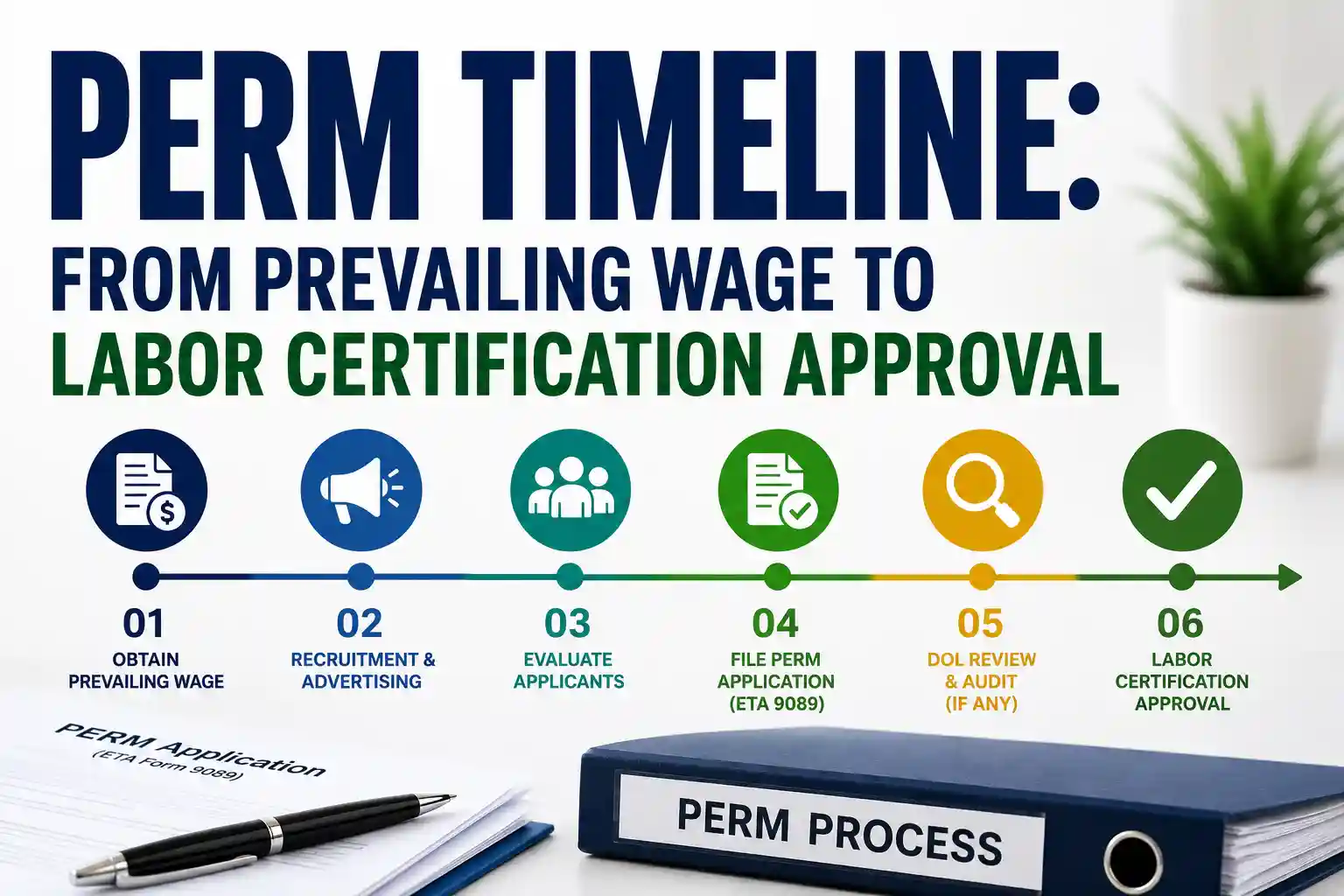
- Prevailing wage request – The employer obtains a wage determination that generally sets the minimum wage the employer must offer for the sponsored role
- Recruitment period – The employer completes required recruitment steps, such as job postings and advertisements, to test whether there are able, willing, qualified, and available U.S. workers for the position
- Case preparation – Employer or counsel drafts the application and ensures consistency across all materials
- PERM filing – The labor certification is submitted to the Department of Labor
- DOL review – The process may include standard processing or additional review such as an audit
- Post-decision steps – Typically includes I-140 filing and further green card processing
Each stage carries its own timing considerations, and delays in one stage can affect the overall timeline.
What Can Make the PERM Timeline Longer
Several factors can affect the PERM timeline and cause delays.
Some factors include:
- Prevailing wage request delays arise from government backlog or the need to clarify job duties, location, or wage level assumptions before a determination is issued
- Some recruitment timing rules are fixed by regulation. For example, certain recruitment steps must generally occur within the required pre-filing window, and mistakes may force the employer to restart or repeat recruitment before filing
- Case specific details may contain inconsistencies between job requirements, recruitment results, and the application, which can trigger additional review or require correction before filing
- PERM filing errors in the application itself, including incorrect dates, wage details, or employer information, may trigger delays or scrutiny
- DOL’s processing delays, which may occur due to agency workload or when a case is selected for audit, which requires submission of recruitment documentation and additional evidence
- A denial, request for reconsideration, or appeal can add significant time and may prevent the case from moving to the I-140 stage unless the issue is resolved or a new strategy is pursued
Why PERM Timelines Vary from Case to Case
| Factor | High-level impact |
|---|---|
| Case preparation | Well-prepared cases may move more predictably through filing and review stages |
| Government workload | Backlogs and agency resources may affect how quickly cases are processed |
| Audit or follow-up review | Audits or requests for additional information may extend the timeline significantly |
| Strategy decisions | Employer decisions about timing, role structure, or recruitment approach may influence the overall process |
As of April 30, 2026, DOL reported that PERM analyst review was working on cases with February 2025 priority dates, audit review was working on November 2025 cases, and the average PERM analyst review time for March 2026 determinations was 501 calendar days, based on recent PERM updates.
These figures change regularly, so it’s vital to check current DOL processing times when planning.
How PERM Timing Affects Applicants and Employers
PERM timing can affect the following:
- When an I-140 is filed
- When a priority date is established
- How long an individual must maintain underlying work authorization
Applicants often ask whether the PERM or the I-140 controls the priority date. In employment-based cases that require labor certification, the priority date is generally the date DOL accepts the labor certification application for processing.
However, I-140 approval timing and visa availability are separate issues, so PERM approval does not by itself mean the person can immediately receive a green card.
Why This Matters
The PERM timeline can shape broader green card planning.
Applicants and employers often need to plan for a longer process.
What Applicants and Employers Can Do During the Wait
The PERM process involves a significant waiting period after filing, during which the Department of Labor reviews the application.
Instead of waiting passively, both applicants and employers can take proactive steps to maintain compliance, prepare for the next stages of the green card process, and manage potential issues that may arise during this extended timeline.
Here are some actions applicants and employers can take while waiting:
- Keep records organized, including recruitment documentation and filing copies, in case of audit or follow-up
- Stay aligned with the employer regarding job role, work location, and long-term sponsorship plans
- Monitor case progress and be prepared for possible requests or additional review
- Prepare for later filings, which may include gathering documents for the I-140 and, when a visa is available, adjustment of status or consular processing
- Review status-related planning to ensure continued work authorization during the process
- Discuss whether any alternative or parallel strategies may be appropriate, such as a different employment-based category, if the person may qualify
When Legal Guidance May Help
Legal guidance becomes particularly important where PERM is no longer just a filing step, but a driver of broader immigration strategy.
For example, if processing delays intersect with expiring nonimmigrant status, job changes, or long-term sponsorship planning, the timing and structure of the PERM case may need to be evaluated alongside other options.
It may also be useful where risk factors are present within the PERM itself. These include:
- Cases with complex job requirements
- Overlapping duties across roles
- Prior filings for the same position
- Recruitment outcomes that could raise questions about the availability of U.S. workers.
In these situations, how the case is framed and documented can affect whether it proceeds smoothly or triggers additional review.
Legal review can also help where consistency across filings matters over time. PERM information often carries forward into later stages such as the I-140 and adjustment of status. Addressing inconsistencies early, rather than after filing, may reduce the likelihood of delays or complications later in the process.
Legal counsel can also help evaluate whether withdrawing and starting over may be appropriate in a particular case.
If PERM timing affects larger strategy decisions,
legal guidance may help clarify next steps.
Frequently Asked Questions
-
- Q: What is the PERM timeline?
- A: It refers to the full process of obtaining a labor certification, including prevailing wage determinations, recruitment, filing, and government review.
-
- Q: What stages are included in the PERM timeline?
- A: The main stages include prevailing wage determination, recruitment, case preparation, filing, and DOL review.
-
- Q: How long does the PERM process usually take?
- A: It varies. The timeline may include prevailing wage processing, recruitment, filing, DOL review, and possible audit review. As of April 30, 2026, DOL reported PERM analyst review was working on February 2025 cases, but this changes regularly.
-
- Q: Why does the PERM timeline vary?
- A: Differences in case preparation, government workload, and whether additional review is required can all affect timing.
-
- Q: What can delay a PERM case?
- A: Audits, inconsistencies in the filing, recruitment issues, and overall agency workload are common factors.
-
- Q: Does every employment-based green card case require PERM?
- A: No. Some categories, such as certain EB-1 cases and EB-2 National Interest Waiver cases, do not require the standard PERM process. Schedule A cases follow special labor certification procedures and generally do not go through the same standard PERM recruitment process.
-
- Q: What happens after PERM is approved?
- A: After PERM is certified, the employer typically files Form I-140 with USCIS. Depending on visa availability and the applicant’s situation, later steps may include adjustment of status in the U.S. or immigrant visa processing through a U.S. consulate.
-
- Q: Can an audit delay the PERM timeline?
- A: Yes. An audit may require additional documentation and extend the review period significantly.
-
- Q: Is there any way to speed up the PERM process?
- A: There is no premium processing for PERM through DOL. Careful preparation may help avoid preventable delays, but DOL processing speed is generally outside the applicant’s and employer’s control. After PERM approval, premium processing may be available for many I-140 petitions.
-
- Q: When should I talk to an immigration lawyer about PERM timing?
- A: If your case involves audits, timing concerns, job changes, or broader strategy questions, legal guidance may help clarify your options.
Conclusion
The PERM timeline is a multi-step process that requires careful coordination between employers, the sponsored worker, counsel where applicable, and government agencies.
While timing can vary, understanding how each stage functions can help set realistic expectations and support better planning.
Preparation, consistency, and awareness of possible delays can help employers and sponsored workers plan more realistically for this stage of the employment-based green card process.



Michael Ashoori, Esq.
President of Ashoori Law
I’m a U.S. immigration lawyer and I help families, professionals, investors, and entrepreneurs get visas, green cards, and citizenship to the United States.
Since starting my law firm, I’ve helped thousands of people from all over the world with their immigration needs. I’m very passionate, hard-working, and committed to my clients.
Got a question? Send me an email.