
Immigration Guides
The U.S. Citizenship and Immigration Services (USCIS) has restored its officers’ full discretion to deny an immigration benefit request without first issuing a Request for Evidence (RFE) or a Notice of Intent to Deny (NOID). That authority took effect on August 5, 2026 under Policy Alert PA-2026-05, and immediately applied the moment it was published and reached pending cases.

USCIS does not offer premium processing for Form I-130. There is no fee that buys a faster decision on a family petition, no upgrade to request, and no version of Form I-907 that applies. Anyone offering to accelerate an I-130 in exchange for payment is describing a service that does not exist.

Delays in immigration processing have become a common source of stress and frustration for applicants and their families. Whether you are waiting for a work visa, green card, or another benefit, long waits can create uncertainty and stress in your personal and professional life. While there is no guaranteed way to fast track every…

No, not by itself, if you were inspected and admitted or paroled when you entered the United States and your spouse is a U.S. citizen. Immediate relatives of U.S. citizens are exempt from the adjustment bars at INA 245(c) that would otherwise disqualify someone who failed to maintain lawful status, violated the terms of a nonimmigrant admission, or worked without authorization, and no waiver is required for those issues.

There is no single timeline for a marriage green card. The total time is the sum of separate stages, and each stage has its own clock. The most current timing figures are the ones posted on the live USCIS Processing Times tool and, for consular cases, the Department of State’s National Visa Center (NVC) and embassy pages, because those figures change month to month and are estimates, not commitments.

The E-2 visa never converts into a green card on its own. A treaty investor who wants permanent residence must qualify under a separate immigrant category and file a separate petition: EB-5 (immigrant investor, Form I-526 or Form I-526E), EB-2 with a National Interest Waiver (self-petitioned Form I-140), EB-1A extraordinary ability (self-petitioned Form I-140), EB-1C multinational manager or executive (Form I-140 filed by the U.S. company), employer-sponsored EB-2 or EB-3 through labor certification, or a family-based petition such as marriage to a U.S. citizen.
The EB1 visa is an immigrant visa classification which is broken in to 3 distinct sub-categories: 1. EB1A for people with extraordinary abilities; 2. EB1B for outstanding professors and researchers; and 3. EB1C for multinational managers and executives. If you have any…
We are excited to dive into a crucial topic that often perplexes many in the world of immigration law. I’m Michael Ashoori, and in today’s discussion, we are unraveling the differences between E2 change of status and E2 visas, particularly tailored to benefit our…

The L1 visa, often referred to as the intracompany transferee visa, is a vital gateway for foreign companies to transfer employees as managers, executives, or specialized knowledge workers to work for a related company in the United States. Unlike the initial L1 process, there are several nuances and factors to consider when renewing the L1 visa, and we’re sharing…

If you’re considering applying for an E2 investor visa, you may have questions about how funding your investment through a loan will impact the overall investment amount. In this blog post, we will delve into these questions and provide you with essential information to…

Green card holders, also called lawful permanent residents or “LPRs,” often express concern about their rights and responsibilities when navigating the differing immigration enforcement policies of various presidential administrations. It is helpful to “bottom line” one piece of critical information so everyone understands: no matter what president is in office, any non-U.S. citizen, including green card and visa holders, can be denied entry into the United States…

EB-5 concurrent filing lets an investor who is already in the United States file the green card application (Form I-485, Adjustment of Status) at the same time as the investor petition (Form I-526E), or while the I-526E is pending, instead of waiting years for the petition to be approved first.
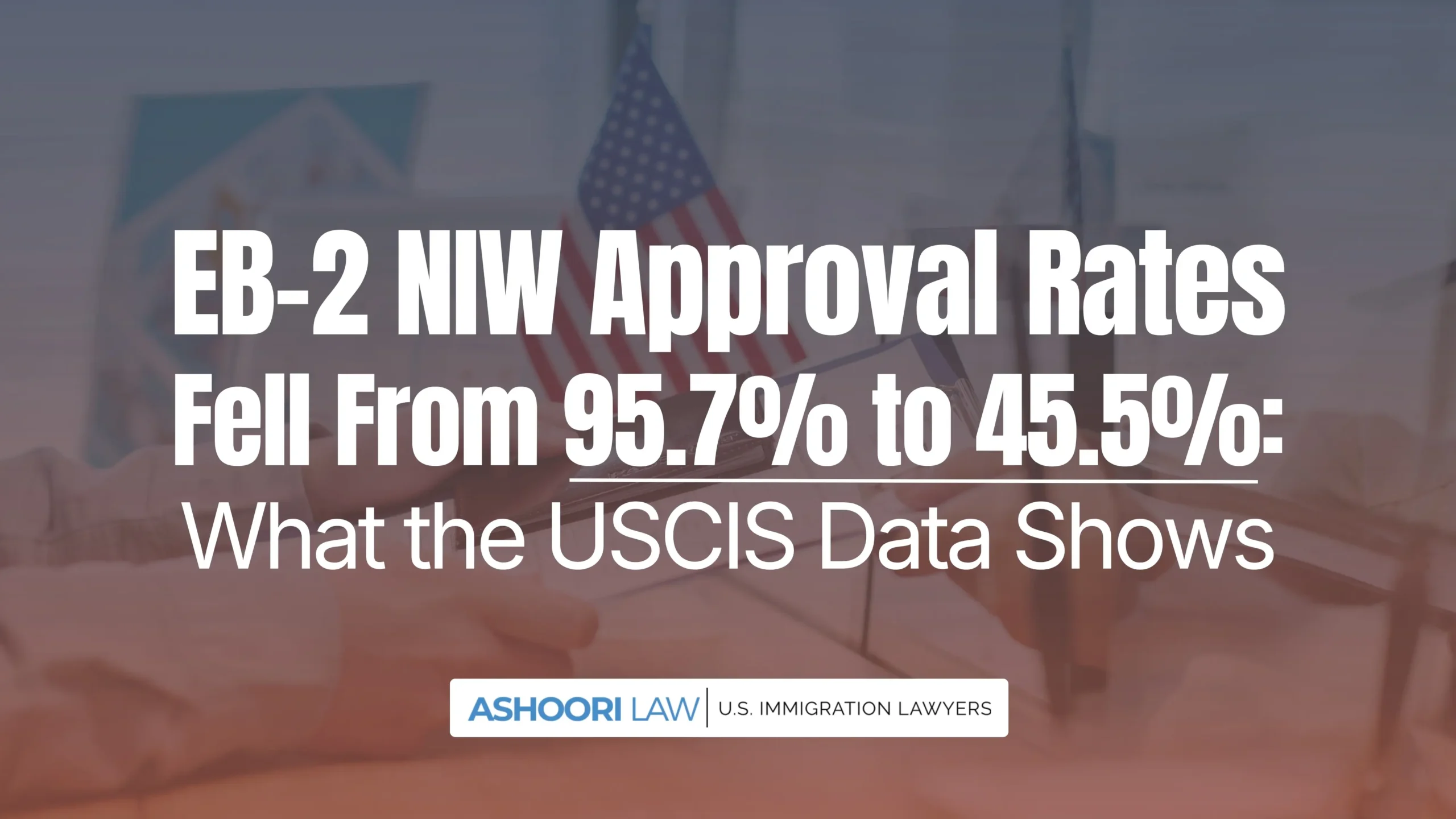
In fiscal year 2022, USCIS approved 95.7 percent of the EB-2 national interest waiver petitions it decided. In the first half of fiscal year 2026, it approved 45.5 percent. Denials outnumbered approvals across those two quarters, 6,486 to 5,410.
EB-1A (extraordinary ability) is the harder category to qualify for, and EB-2 NIW (National Interest Waiver) is the more accessible one. In recent Visa Bulletins, EB-1 cutoff dates have been more favorable than EB-2 dates, although visa availability changes monthly by preference category and country of chargeability, so the current bulletin controls.
The 60-day grace period for nonimmigrant workers remains in force today. DHS has submitted a proposed rule that would eliminate it, but that proposal is at an early stage of review, its text has not been made public, and no final rule or effective date exists.


Michael Ashoori, Esq.
President of Ashoori Law
I’m a U.S. immigration lawyer and I help families, professionals, investors, and entrepreneurs get visas, green cards, and citizenship to the United States.
Since starting my law firm, I’ve helped thousands of people from all over the world with their immigration needs. I’m very passionate, hard-working, and committed to my clients.
Got a question? Send me an email.